For many years, CNC machining has been renowned for its high precision and stability. Nevertheless, manufacturing enterprises are still confronted with challenges such as equipment downtime, rising labor costs, material waste and shortened lead times. Artificial Intelligence (AI) is changing this situation. By analyzing equipment and production data, it helps enterprises optimize machining parameters, predict equipment failures, improve inspection efficiency and cut production costs.
AI runs through the entire workflow from quotation and programming to production and inspection. Before machining, AI assists with quotation, process planning, feature recognition and tool‑path optimization to reduce programming and commissioning time. During machining, real‑time monitoring of cutting force, vibration, temperature and tool wear enables predictive maintenance and adaptive control. After machining, AI‑powered visual inspection and data analysis can quickly identify defects and improve product consistency.
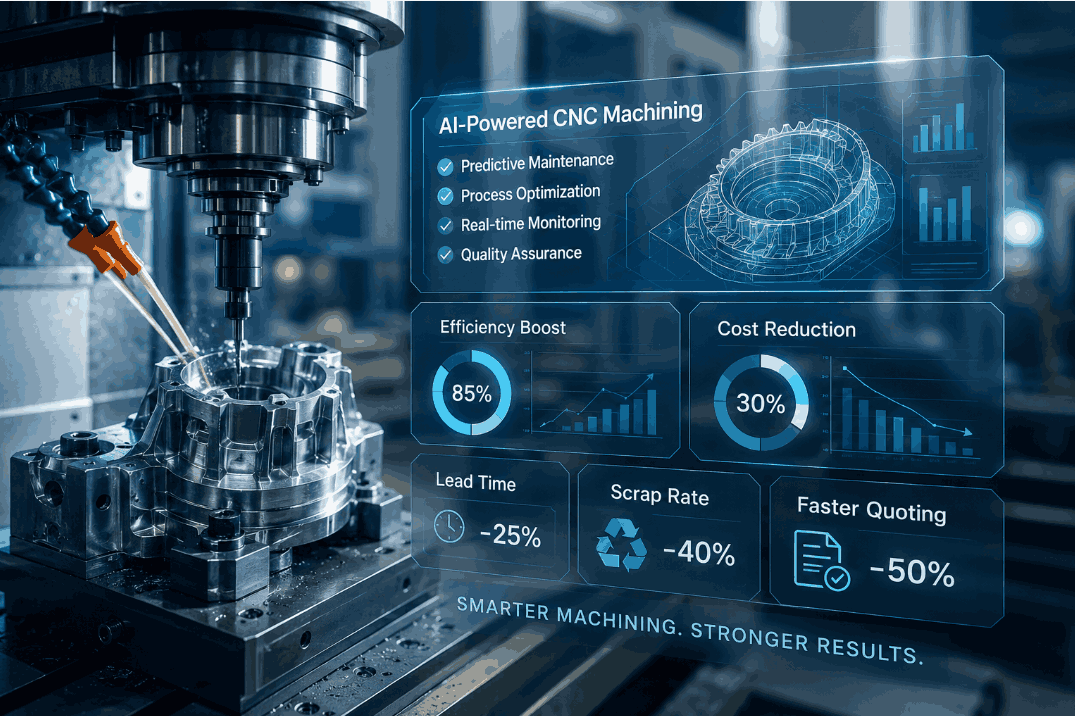
Drawing on massive historical machining data, AI can identify better cutting parameters to shorten machining cycles and raise equipment utilization while guaranteeing product quality. Meanwhile, the system can detect anomalies in a timely manner to reduce dimensional deviations and material waste, thus lowering the scrap rate. These advantages are particularly prominent in sectors with strict requirements for tolerances and consistency, such as aerospace, medical devices, automobiles and precision industrial components.
 Can AI reduce manufacturing costs?
Yes. Predictive maintenance detects abnormalities in components including spindles, bearings and cutting tools in advance to minimize unplanned downtime. Real‑time monitoring during production spots machining deviations early and prevents defective parts from moving on to subsequent processes. Higher equipment utilization, less material waste and lower maintenance costs ultimately translate into more competitive manufacturing costs.
AI serves primarily as an assistant to engineers rather than a replacement. Experienced programmers, operators and quality engineers remain responsible for process selection, program verification and complex problem‑solving. AI handles data analysis and repetitive tasks, allowing professionals to focus more on engineering‑related decision‑making.
AI is evolving from a standalone automation tool into a key component of smart manufacturing. For customers demanding high precision, short lead times and consistent quality, selecting manufacturing partners with digital capabilities, sound quality management systems and professional machining experience will grow increasingly important.
HAOZHIFENG keeps track of advances in CNC machining technology and smart manufacturing. Leveraging professional machining capabilities, quality control and digital technologies, we deliver stable and efficient custom component manufacturing services for global clients.
Ready to schedule your next batch of CNC machining production? Contact us right away.