A QR code on a metal part may look simple. Scan it, and the user can open a page with product information. But the real challenge is not printing the code. It is making sure the information behind it is accurate, useful, and linked to the actual part.This is one of the issues behind the development of the Digital Product Passport (DPP) in the European Union.The European Commission is working on DPP requirements for different product groups. Iron and steel are among the priority groups, with the adoption of product-specific requirements indicated for the fourth quarter of 2026. The exact requirements will depend on the relevant legislation. This does not mean that every custom metal component currently needs its own digital passport.For metal manufacturers and parts suppliers, however, the direction is worth watching. Product information and traceability may become more important in some supply chains.
For a custom metal part, the drawing defines dimensions, tolerances, materials, and other technical requirements. During production, additional records may be created.For example, a machined steel bracket may have a specified steel grade, hole positions, coating requirements, and dimensional tolerances. Depending on the customer's requirements, the supplier may also need to keep material certificates, inspection results, production batch information, and surface treatment records.These documents answer different questions.A drawing explains what the part should look like. A material certificate provides information about the supplied material. An inspection report records whether the measured dimensions meet the specified requirements. Batch records can help identify which parts were produced from a particular material lot or production run.If these records are stored separately and cannot be connected to the delivered parts, finding the right information later can take time. A digital record is useful when it helps connect these details in a clear and reliable way.
The information needed depends on the type of component and the customer's quality requirements. For many custom metal parts, it is practical to start with a few basic records:
• Part identification: Part number, drawing revision, order number, and batch or lot number where applicable.
• Material information: Material grade and relevant material certificates, when required.
• Inspection results: Key dimensions, measurement results, and inspection documents.
• Surface treatment: The specified finish and relevant process or inspection records, where applicable.
• Production and delivery records: Relevant production dates, batch details, and shipment documentation.
Not every part needs every record. A simple bracket used in a general-purpose application may require less documentation than a component used in safety-critical equipment or a tightly controlled industrial system.
The purpose is not to create more paperwork. It is to keep the information that customers may need and make it possible to retrieve that information without searching through multiple files and email threads.
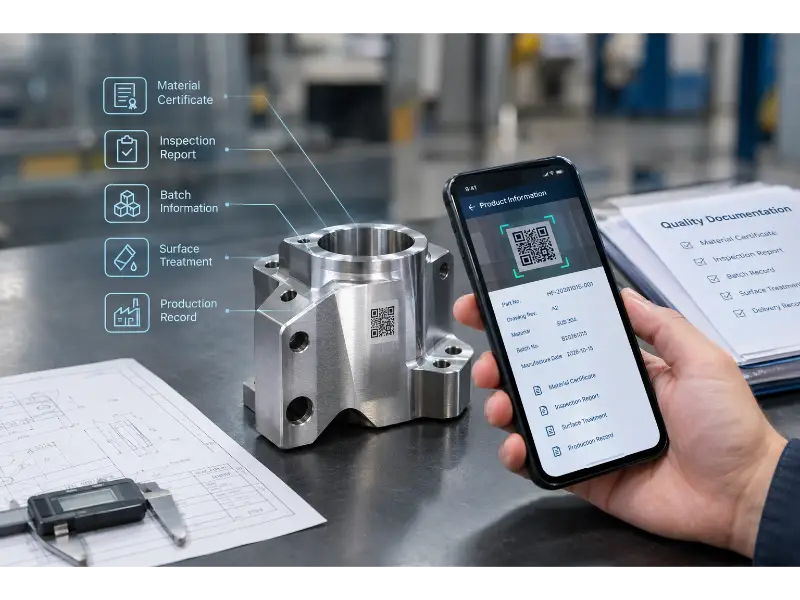
Adding a QR code to a product does not automatically make its information traceable.If the code opens a generic product page, it may tell the customer very little about the specific part or batch received. If the linked documents are outdated, incomplete, or incorrectly matched to the order, the code does not solve the underlying problem.
A useful digital record needs a reliable link between the product identity and its supporting information. The supplier also needs a process for updating records when drawings change, a new material batch is used, or inspection results are revised.For customized production, this can be more complicated than it appears. Two parts may look identical but have different drawing revisions, material grades, or surface treatment requirements. The records need to distinguish between them.Access control also matters. Customers may need material and inspection documents, but they do not necessarily need access to a supplier's full production process, internal costing, or confidential information about other customers.
For suppliers working with multiple production partners, traceability depends on coordination as much as on software.Material information may come from one source, machining records from another, and surface treatment records from a third. If part numbers, batch references, and document versions are not consistent, collecting the records at the end of production can become difficult.A practical starting point is to establish a clear record for each order or production batch. The record can link the approved drawing, material information, inspection results, surface treatment requirements, and final delivery documents.Suppliers should also confirm with customers which records are required before production begins. This avoids preparing unnecessary documents while reducing the risk of missing an important certificate or inspection report at shipment.For companies exporting to Europe, it is important to follow the product-specific DPP rules as they are finalized. The EU framework is being introduced progressively, and the exact obligations depend on the product group and applicable legislation.
A digital passport does not replace good manufacturing control. If the material grade is recorded incorrectly or an inspection report is linked to the wrong batch, putting the information online will not make it reliable.The first step is to make the underlying records accurate and consistent. Digital tools can then make those records easier to connect, retrieve, and share with authorized users.
At HAOZHIFENG, custom metal parts are produced according to customer drawings and project requirements. For each project, material specifications, dimensional requirements, surface finishing, and inspection documentation should be confirmed according to the agreed scope.
As product traceability develops, the ability to provide the correct technical records may become an increasingly important part of supplying custom metal components. The QR code is only the visible part. The quality of the information behind it is what makes the system useful.
Source: European Commission, Digital Product Passport and Iron & Steel information pag