For industrial buyers, choosing a manufacturing supplier is no longer simply about finding the lowest unit price. As product development cycles become shorter and supply chains face more uncertainty, many buyers are looking for suppliers that can manage several manufacturing processes within one coordinated system.This is driving growing interest in integrated manufacturing suppliers that can provide machining, casting, finishing, inspection, assembly and related services through one supply chain.
Traditional sourcing often involves several suppliers. One company handles casting, another performs CNC machining, while surface treatment, inspection and packaging may be outsourced to additional vendors.Although this approach can sometimes reduce individual processing costs, it also creates more handoffs. A delay at one stage can affect the entire production schedule. Different suppliers may also interpret drawings, tolerances and quality requirements differently.By working with an integrated supplier, buyers can reduce the number of communication points and establish clearer responsibility for the complete production process. Recent manufacturing supply-chain discussions have increasingly emphasized supplier consolidation as a way to reduce operational complexity and improve control.
Engineering projects rarely remain unchanged from the first drawing to final production. Material selection, machining methods, tolerances and finishing requirements may need to be adjusted during development.
An integrated supplier can provide engineering feedback earlier because different manufacturing processes are considered together. For example, a cast component may be reviewed with its subsequent CNC machining requirements in mind, helping engineers avoid unnecessary machining allowance, difficult features or repeated design changes.This becomes particularly valuable for customized industrial components and small-batch production, where development speed can be just as important as production cost.
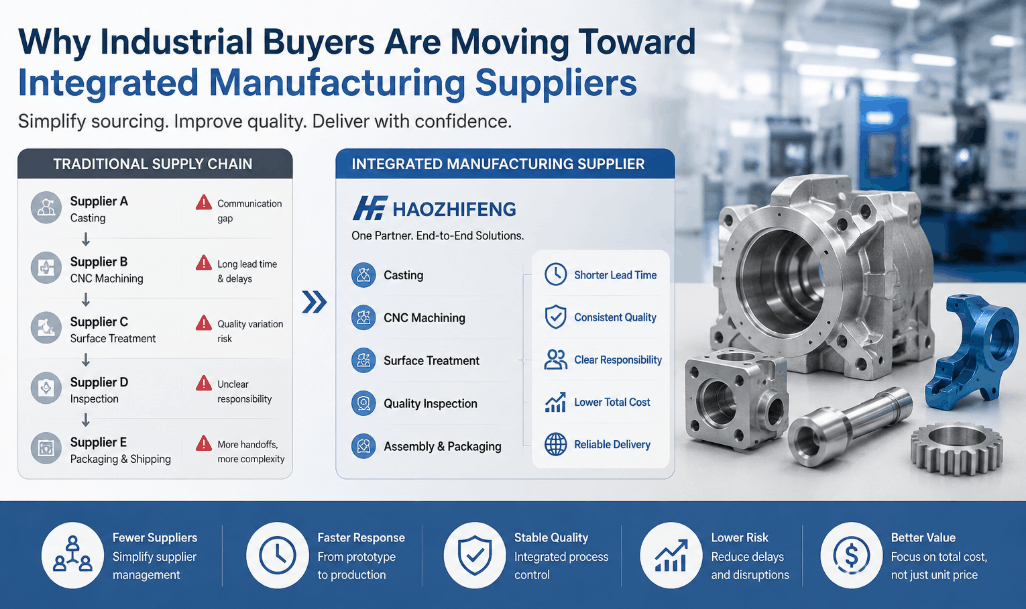
Quality problems often occur at the interfaces between processes. A component may meet requirements after machining but encounter dimensional or surface issues during subsequent finishing.When several processes are coordinated by one manufacturing partner, inspection standards, production schedules and technical communication can be managed more consistently. This gives buyers better visibility from raw material preparation through final inspection.For industries such as industrial equipment, automation, energy systems and machinery, this level of process control can help reduce rework and unexpected delays.
The shift toward integrated suppliers does not mean buyers are simply looking for a company that offers “everything.” Manufacturing capability still needs to be supported by engineering knowledge, quality control, reliable communication and scalable production capacity.For companies such as HAOZHIFENG, the opportunity is to become more than a parts supplier. By coordinating processes such as CNC machining, casting, prototyping and related production services, an integrated manufacturing partner can help customers simplify sourcing while maintaining technical and quality requirements.
As industrial supply chains continue to prioritize flexibility, delivery reliability and risk control, the value of an integrated manufacturing partner is becoming increasingly clear. The question for buyers is no longer only “Who can make this part at the lowest price?” but also “Who can manage the entire process reliably?”